

Foundation training
Certified Reliability Engineer
Understand reliability, evaluate failures and plan tests better.
- 5Modules
- 65Learning videos
- 36Knowledge checks
- 11Practical exercises
- 1Online exam
Why participate?
Identify failure risks earlier and reduce them systematically
What you gain from the training
Identify weaknesses earlier
Make risks visible early in development and testing.
Assess data with greater confidence
Use field, lifetime and failure data to support technical decisions.
Plan tests with a clear rationale
Define test scope and evidence to match the question at hand.
Align decisions across the team
Discuss risks and evidence clearly across development, testing and quality.
Programme content
Select a module
Module 1
Fundamentals of reliability engineering
- Classify reliability in the development process
- Differentiate qualitative and quantitative methods
- Interpret failure rates and life characteristics
- Evaluate characteristic values of a technical component

Module 2
Apply qualitative methods
- Select FMEA and FTA appropriately
- Structuring error causes and error sequences
- Technical risks comprehensibly prioritise
- Analyse error paths of a technical system
Module 3
Analyse life data
- Differentiate field and experimental data
- Accurately consider censored data
- Derive service life characteristic values loadable
- Analyse a life data set with censored observations

Module 4
Calculate system and component reliability
- Imaging system structures as a block diagram
- Calculate system reliability with the Boole method
- Detecting weaknesses and improvement levers
- Calculate system reliability and specifically improve it

Module 5
Planning tests and demonstrating reliability
- Define test targets and reliability demonstrations
- Plan sample, duration and burden
- Reliable evaluation of test results
- Derive a suitable test strategy for a product

What the training includes
100% online
For beginners
11 practical exercises
Recognised qualification
Learning objectives
What you will learn
You apply the content through exercises and case studies from Reliability Engineering.
- Systematically assess product and process reliability
- Classify and apply qualitative methods such as FMEA and FTA
- Analyse life data from field use and testing
- Calculate system reliability and identify optimisation approaches
- Plan tests and prepare transparent reliability demonstrations
Practice
Typical problems from practice
- Early field failures
Analyse causes with FMEA or FTA and prioritise risks.
ProblemComplaints occur even though the internal tests have been passed.
Solution in the training- Separate the failure mode from its cause systematically.
- Prioritise risks with FMEA or FTA.
- Incomplete test data
Reliably analyse failures, operating times and censored observations.
ProblemOnly a few test specimens fail; Others reach the end of the test.
Solution in the training- Correctly consider censored data.
- Derive load-bearing lifetime characteristics.
- Inefficiently planned tests
Plan tests efficiently and define clear reliability demonstrations.
ProblemThe attempt takes a lot of time, but does not provide a clear decision.
Solution in the training- Define test goal and detection in advance.
- Appropriately plan the sample, duration and load.
Target group
Which areas of reliability do you work in?
Customer Requirements & Product Targets
- Assess and negotiate customer requirements in a well-founded manner.
- Critically examine requirements, assumptions and verifiability.
- Classify consequences for test scope, warranty, goodwill, service costs and provisions earlier.
- Product management
- Technical sales
- Project management
Development and construction
- Include reliability earlier in product decisions.
- Consider reliability requirements in the design.
- Evaluate risks and better justify technical decisions.
- Development
- Construction
- Systems engineering
Quality & Testing
- Plan tests and reliability demonstrations transparently.
- Evaluate error images and risks in a more structured way.
- Provide a technical rationale for test scope and reliability evidence.
- Quality
- Supplier Quality
- Test and validation
Field, Service & After Sales
- Learn systematically from complaints and field failures.
- Better classify failure patterns and technical risks.
- Feed the findings back into product, quality and management decisions.
- Technical service
- After sales
- Field data analysis
Exam and certification
Path to certification
5Modules
65Learning videos
36Knowledge checks
11Practical exercises
Online exam
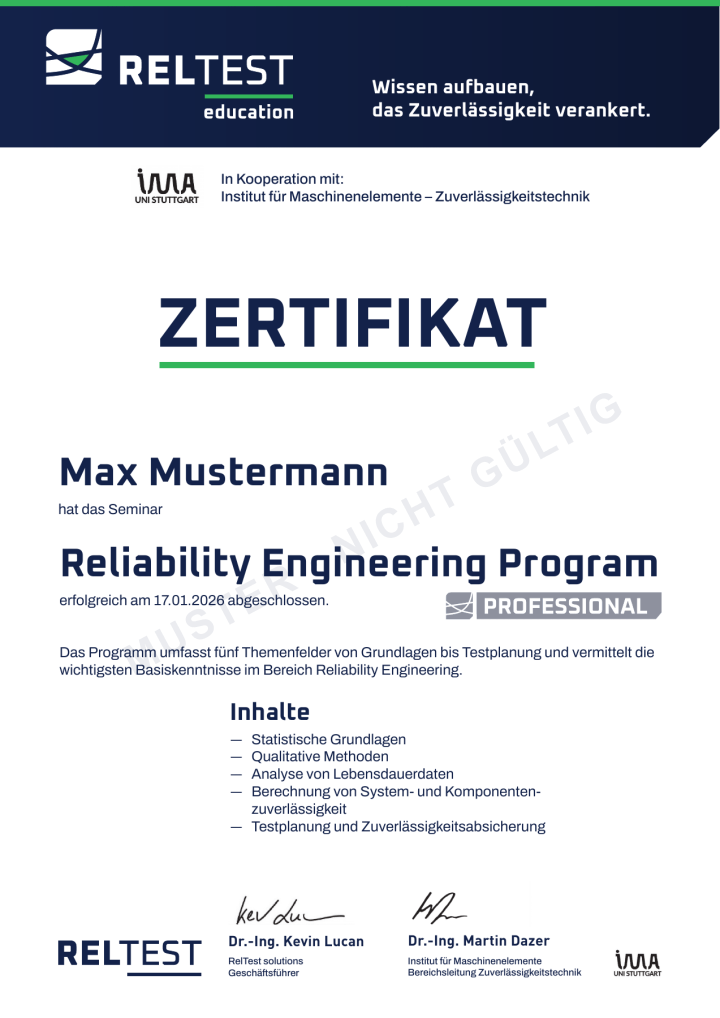
Certificate
The qualification
Certified Reliability Engineer
- Certified Reliability Engineer
- Certificates of participation for modules completed through RelTest Education
- Basis for the professional expert training
The Certified Reliability Engineer certificate is issued in cooperation with the University of Stuttgart.
Details
Services and price
Included in the programme
- Learning scope5 modules, 65 learning videos, 36 knowledge checks and 11 practical exercises
- AccessLearning platform for web and mobile, up to 12 months
- DocumentationDigital seminar materials and media library
- QualificationOnline examination and certificate in cooperation with the University of Stuttgart
- Prerequisites
- None. The training is also suitable for beginners.
- Learning pace
- E-learning via the online platform, without a fixed schedule and with access for up to 12 months.
- Technology
- Access via PC, tablet or smartphone. Minitab is required for exercises; a trial licence is sufficient.
FAQ
Frequently asked questions about the programme
Answers about prerequisites, course format, technical requirements and qualification.
Do I need prior knowledge of reliability engineering?
No. The training is also suitable for beginners. The five modules start with the fundamentals of reliability engineering and progress through methods, life data, system reliability and test planning.
Is the training completely online?
Yes. You learn through the online platform without a fixed schedule and have access for up to 12 months. This lets you work through videos, exercises and knowledge checks at your own pace.
What technical equipment and software do I need?
You can participate via PC, tablet or smartphone. For the exercises, we use and recommend Minitab; a trial licence is sufficient. However, the analysis can be performed with any common statistical software.
How does the exam work?
The online exam takes place directly on the learning platform. It is part of the programme and the Certified Reliability Engineer qualification.
What certificate do I receive?
After successful completion, you receive the Certified Reliability Engineer certificate. It is issued in cooperation with the University of Stuttgart and supplements the certificates of attendance for the modules you have completed.
Next step
Does the Certified Reliability Engineer fit your job?
We will discuss whether the content, course format and qualification suit your role or team.