

Expert Training
Testing
Plan reliability tests, assess test strategies and design sound reliability demonstrations.
- 5Modules
- 58Learning videos
- 34Knowledge checks
- 9Practical exercises
- 1Online exam
Why participate?
Plan tests efficiently and provide robust evidence
What you gain from the training
Translating test targets
Link reliability requirements to operating conditions, failure criteria and the required confidence level.
Planning test scope
Define the sample size, test duration and stress required for the reliability demonstration.
Evaluating acceleration
Increase test conditions without changing the relevant failure mechanism.
Compare strategies
Compare success run, accelerated and degradation-based test approaches.
Programme content
Select a module
Module 1
Introduction and review of reliability testing
- Classify objectives and types of reliability tests
- Translate reliability requirements into specific test targets
- Define operating conditions, failure criteria and the required confidence level
- Translate a technical requirement into a clear test task
Module 2
Success Run Test & Bayes' Theorem
- Determine sample size and test duration for fail-free tests
- Assess the target reliability and confidence level together
- Include robust prior knowledge with the Bayes theorem in the test planning
- Plan a success run test using both the classical method and prior knowledge

Module 3
Accelerated Life Testing
- Select suitable loads and steps for accelerated tests
- Relevant failure mechanism obtained under increased load
- Test results transferred to use with a technically justified model
- Derive an accelerated test from the operational profile and failure mechanism

Module 4
Life estimation by degradation test
- Distinguishing failure and degradation data
- Select measures, thresholds and suitable trend models
- Estimating remaining service life from continuous or discrete state data
- Model degradation data and determine the remaining lifetime up to the limit value

Module 5
Comparison of test strategies & detection planning
- Compare test approaches according to technical risk, effort and significance
- Combine sample, test duration and load into a detection plan
- Document assumptions, decision rules and limits of proof
- Select and justify a test strategy for a specific product task
What the training includes
Live online or in person
For advanced learners
With reliability demonstrations
With expert certificate
Learning objectives
You learn this in expert training
You apply the content through exercises and case studies from Reliability Engineering.
- Translating reliability requirements into specific test targets and failure criteria
- Plan and assess Success Run Tests using both classical and Bayesian methods
- Link Accelerated Life Testing to operating conditions and failure mechanisms
- Select degradation measures and thresholds for remaining-life forecasts
- Justify test strategies and demonstration plans based on risk, effort and strength of evidence
Practice
Typical tasks in test planning and reliability demonstration
- Limited number of units
Plan a success run test with an appropriate confidence level.
ProblemOnly a small number of test units and a limited time window are available for the reliability demonstration.
Solution in the training- Consider the sample size, test duration and demonstration target together.
- Compare a classical demonstration with the use of reliable prior information.
- Long service life
Provide a technical rationale for an Accelerated Life Test.
ProblemThe required deployment period cannot be verified within the project duration under normal conditions.
Solution in the training- Select accelerating load to match the failure mechanism.
- Check transferability for operational conditions and model limits.
- No failures in the test
Use degradation data for lifetime estimation.
ProblemNo failures occur during the available test period, but a measurable state variable changes continuously.
Solution in the training- Adequate measurand and technical threshold value.
- Evaluate trend model and estimate remaining life up to the limit.
Target group
Which areas of reliability do you work in?
Technical decisions and evidence
- Assess test effort and confidence in the evidence for technical decisions.
- Understand the strength and limitations of a reliability demonstration.
- Consider test scope and technical risk for release decisions.
- Technical project management
- Product management
- Reliability management
Reliability and Development
- Derive test targets from use, product function and risks.
- Transform operating conditions and failure criteria into testable targets.
- Link acceleration to the relevant failure mechanism.
- Reliability Engineering
- Development
- Systems engineering
Quality & Testing
- Plan tests methodically and assess reliability demonstrations robustly.
- Derive the sample size, duration and stress from the demonstration target.
- Compare test strategies by strength of evidence, effort and risk.
- Quality
- Test engineering
- Validation
Field & After Sales
- Use field experience for realistic test conditions.
- Assess relevant failure modes and stress profiles from field data.
- Compare test conditions with actual use and observed damage.
- Field data analysis
- After sales
- Warranty management
Exam and certification
Path to certification
5Modules
58Learning videos
34Knowledge checks
9Practical exercises
Online exam
Certificate
The qualification
Certified Reliability Expert – Testing
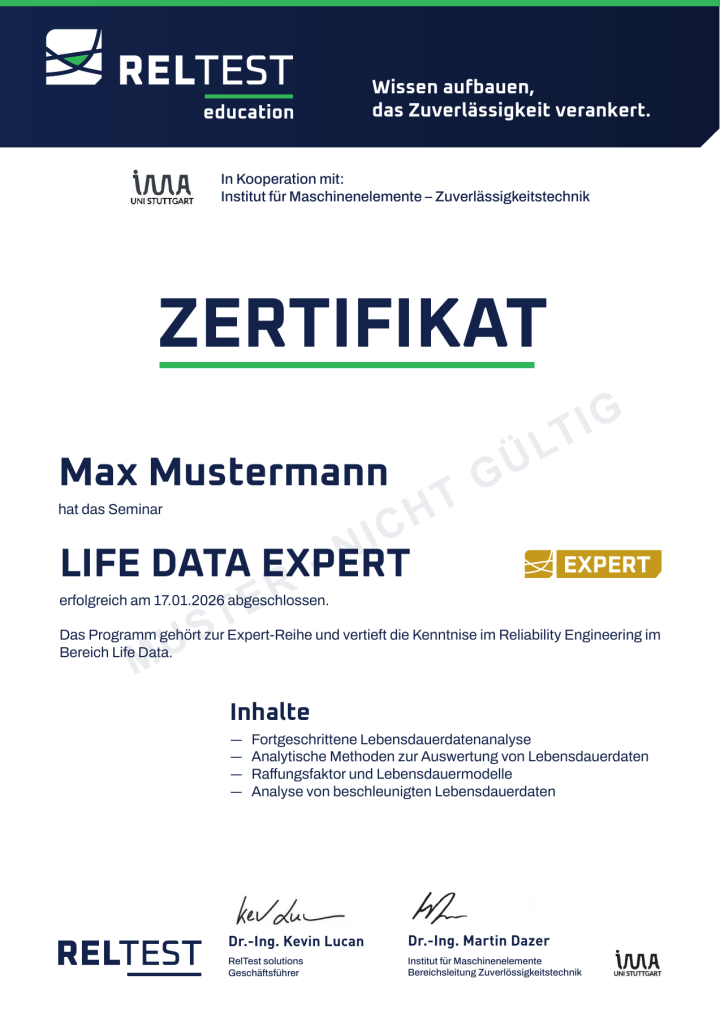
- Certificate “Certified Reliability Expert – Testing”
- Certificates of participation for modules completed through RelTest Education
- Qualification equivalent to Certified Reliability Engineer level
The Certified Reliability Expert – Testing certificate is issued in cooperation with the University of Stuttgart.
Details
Services and price
Included in the programme
- Learning scope5 modules, 58 learning videos, 34 knowledge checks and 9 practical exercises
- AccessOnline learning platform for web and mobile; dates and format by arrangement
- DocumentationDigital seminar materials and media library
- QualificationOnline examination and Certified Reliability Expert – Testing certificate in cooperation with the University of Stuttgart
- Recommendation
- Fundamentals of reliability engineering.
- Learning pace
- Live online or in-person training. The date and format are agreed with participants. Materials and the exam are provided through the online learning platform.
- Technology
- Access via PC, tablet or smartphone. Minitab is required for the exercises; a trial licence is sufficient.
FAQ
Frequently asked questions about the programme
Answers about prerequisites, course format, technical requirements and qualification.
What prior knowledge do I need?
The Certified Reliability Engineer qualification is not required. A foundation in reliability targets, life characteristics, and test planning is recommended.
How does Expert Training take place?
The training is available live online or in person. The date and format are agreed with participants. Materials and the exam are provided through the online learning platform.
What software do I need?
A PC, tablet or smartphone is sufficient to access the learning platform. Minitab is required for the exercises; a trial licence is sufficient.
How does the exam work?
The online exam takes place directly via the learning platform.
What certificate do I receive?
After successful completion, you receive the Certified Reliability Expert – Testing certificate. It is issued in cooperation with the University of Stuttgart.
Next step
Does Expert Training – Testing fit your task?
We clarify with you whether the content and format suit your products, your verification goals, or your team.